The Human Heart Model Clipart PNG: A Comprehensive Resource for Creators and Educators
In the expansive world of digital assets for design and education, clipart featuring anatomical models occupies a unique niche. Among these, a Human Heart Model Clipart PNG represents a specialized tool, bridging the gap between scientific accuracy and creative utility. Unlike generic illustrations, this type of resource is typically a detailed, three-dimensional render of the human heart, isolated on a transparent background. This format offers distinct advantages for a wide array of applications, from commercial printing projects to educational materials.
What Makes This Clipart Distinct?
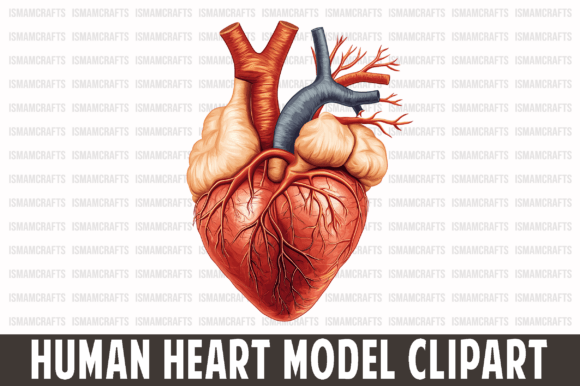
The defining characteristic of a high-quality Human Heart Model Clipart PNG is its combination of realism and flexibility. The "PNG" aspect, with its transparent background, is crucial. This means the graphic can be placed seamlessly onto any other design element—a shirt template, a planner page, a cup mock-up, or a wall art background—without the need for complex digital editing to remove a white or colored backdrop. The "model" descriptor often indicates a 3D-rendered style, suggesting a detailed, textured representation that includes key anatomical features like arteries, veins, and chambers, providing a more dynamic and modern visual compared to flat, diagrammatic illustrations.
Furthermore, specifications like 300 DPI resolution and commercial use allowance are critical practical features. High DPI ensures the image remains crisp and clear when printed on physical items, a necessity for products like shirts, hats, or fine stationery. The commercial license grants creators the freedom to use the asset in sold products, removing a significant legal hurdle often associated with found online imagery. This combination of technical quality and usage freedom positions this clipart as a ready-to-use professional component.
Comparing Formats and Styles: Knowing Your Options
When sourcing heart imagery for a project, understanding the landscape of available formats helps in selecting the right fit. A Human Heart Model Clipart PNG differs from several other common types of medical imagery.
Vector Graphics vs. Raster PNGs
Many clipart sets offer vector files (like SVG or EPS). These are infinitely scalable without loss of quality, ideal for logos or designs that need to be resized dramatically. However, the rich, photorealistic textures and subtle shading of a detailed 3D model are often best captured in a raster format like PNG. The tradeoff is that a PNG, while high-resolution, has fixed dimensions. For most printing and digital projects where the final size is known, a 300 DPI PNG is perfectly sufficient and can offer more visual depth.
Realistic 3D Renders vs. Schematic Diagrams
Another key comparison lies in style. Schematic or line-art diagrams excel in educational contexts where clarity of individual parts and labels is paramount. They are abstract and instructional. A Human Heart Model Clipart PNG, with its realistic texture and lighting, serves a different purpose. It conveys organic complexity and is more visually engaging for applications where the heart is a design element rather than a strict teaching tool—for example, on motivational wall art about health or on a stylish cafe cup for a medical conference. It brings a sense of biological realism to the design.
Photographs vs. Clipart Models
One might consider using an actual photograph of a heart model or specimen. While photographs offer undeniable realism, they often come with challenging backgrounds, lighting inconsistencies, and potential copyright restrictions. A professionally rendered Human Heart Model Clipart PNG is designed for utility: isolated, evenly lit, and consistently colored. This controlled environment makes it a more predictable and easier-to-use asset in a designer’s workflow, especially when integrating with other graphical elements.
Practical Applications and Best-Fit Situations
The provided description lists numerous applications, and understanding where this asset shines helps in deployment. Its strengths are most evident in projects that require both aesthetic appeal and anatomical recognizability.
- Print-on-Demand Products: For creating shirts, hats, or mugs, the transparent PNG is ideal. It can be layered over garment mock-ups or product templates without awkward cropping. The colorful, detailed design makes for a compelling graphic on apparel.
- Stationery and Planners: In educational planners or health-themed journals, this clipart can serve as a decorative element on covers or section pages. Its realistic nature lends a professional, scholarly tone.
- Wall Art and Decals: The high resolution ensures it can be printed at larger sizes for wall decor without becoming pixelated, suitable for both home offices and clinical settings.
- Digital Projects and Infographics: For websites, presentations, or digital infographics about health, cardiology, or biology, the isolated graphic can be combined with text and data seamlessly. It acts as a strong visual anchor.
The tradeoff here is specificity. This clipart is a detailed heart model. It is not a simplified icon. Therefore, for projects needing a tiny, minimalist symbol (like a small app icon), it may be too complex. In such cases, a simpler, vector-based icon might be a better alternative.
When This Clipart Is the Right Choice—and When to Look Elsewhere
Choosing a Human Heart Model Clipart PNG hinges on evaluating your project’s core requirements.
It is likely the right choice when: your project demands a realistic, detailed representation of the heart; you need a file format that easily integrates into multi-layer digital designs (thanks to transparency); you are creating physical printed items and require high-resolution assurance; and you require commercial rights to sell your final product. It serves as a versatile, all-in-one solution for creators who want a ready-to-use, professional-grade anatomical graphic.
You might need to consider another option when: your project requires extreme scalability beyond the provided DPI (where a vector format is safer); your audience requires a schematic, labeled diagram for learning purposes (where an annotated illustration or a custom diagram is better); or you need a stylized, abstract, or cartoonish representation to match a particular brand’s playful tone. Furthermore, if your project focuses on a very specific part of the heart (like only the valves) or a particular disease state, a more specialized medical illustration would be necessary.
Key Decision Factors for Creators and Educators
Before committing to using this or any similar asset, a few practical factors should guide your decision.
- Resolution and Final Output Size: Always match the file’s DPI to your largest intended print size. A 300 DPI PNG is excellent for most items, but for very large wall art, verify the pixel dimensions.
- Color and Style Consistency: Ensure the clipart’s color palette and 3D style align with your overall design theme. A realistic render might clash with a minimalist project.
- Licensing Clarity: The “commercial use allowed” term is vital, but always read the full terms from the provider to ensure there are no unexpected restrictions.
- Editability Needs: Consider if you need to modify the graphic. A PNG is less editable than a vector file. If you need to change colors or separate parts, a different format or a more layered file might be required.
In essence, a Human Heart Model Clipart PNG is a powerful, specialized tool. It eliminates the need for custom illustration or complex photo manipulation for many users. By understanding its distinct properties—the transparent background, high-resolution 3D detail, and commercial license—you can effectively leverage it to enhance both creative and educational projects. Its utility is maximized when the project goals align with its strengths: providing a realistic, integrable, and professionally designed visual of one of our most vital organs.